

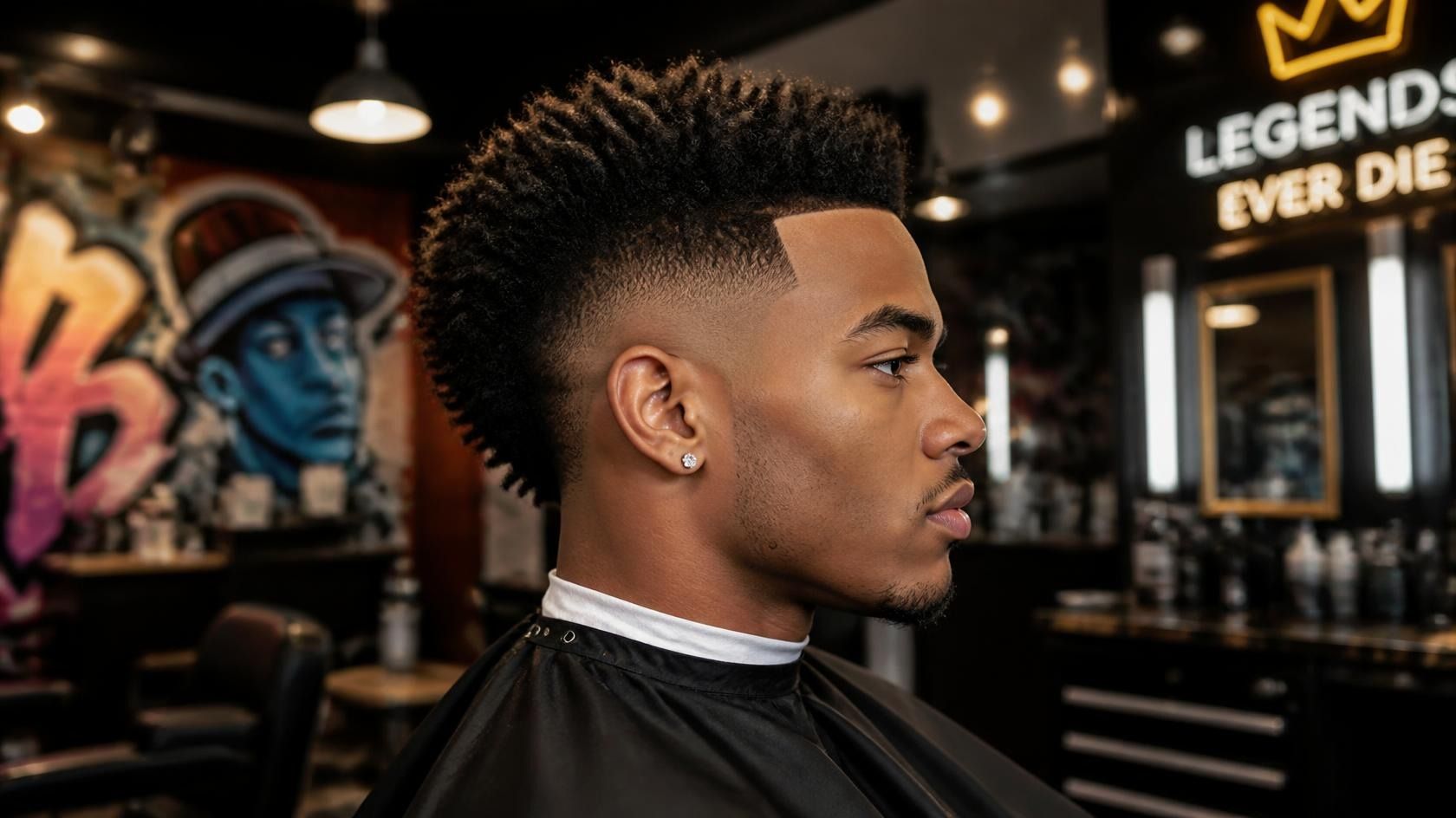
A low taper fade mohawk keeps the sides clean and soft.
It leaves a strip of longer hair down the middle.
It looks bold, but it still feels easy to wear.
This guide shows you what the cut is and how it differs from similar fades.
You’ll also get barber scripts, styling steps, and care tips.
Use it to walk into the shop with a clear plan.
What is a low taper fade mohawk?
A low taper fade mohawk blends a gentle taper on the sides with a longer center strip.
The taper stays low, so the sides keep some hair.
The top does the talking.
Think of it as a softer take on the classic mohawk.
It works for people who want edge without a full shaved look.
That balance is why barbers request it so often.
Where does the low taper sit?
The low taper starts near the sideburns and wraps around the ear.
It ends at the natural hairline at the nape.
The hair gets shorter only a little as it nears the skin.
It doesn’t climb high on the head.
That keeps the temples and upper sides fuller.
The result looks neat, not stark.
What makes the center section a mohawk?
The mohawk is the longer strip that runs from the front hairline to the crown or nape.
The sides sit shorter than the strip, so it stands out.
Width and height change the look.
A narrow strip looks sharper and more punk.
A wide strip looks calmer and easier for work.
Your barber sets this based on your head shape and hair type.
How it differs from a burst fade, skin fade, and faux hawk
These names get mixed up a lot.
The difference comes down to fade shape, fade height, and how much skin shows.
Knowing this helps you ask for the right thing.
Here’s the quick view:
- Low taper mohawk: soft, short blend at the ear and nape
- Burst fade mohawk: curved fade around the ear
- Skin fade mohawk: sides blend down to bare skin
- Faux hawk: no shaved sides, hair is just styled up
Low taper mohawk vs burst fade mohawk

A taper follows the natural hairline in a gradual line.
A burst fade curves in a half circle around the ear and flares at the back.
The burst looks more dramatic.
You can combine them.
A low burst taper gives you the curve with a soft blend.
Ask for it by name if you like that shape.
Mohawk fade vs faux hawk fade

A true mohawk has shorter sides that contrast with the center.
A faux hawk keeps the sides longer and pushes them inward with product.
It’s the safer option if you want to avoid a big change.
The low taper mohawk sits between the two.
It has real contrast, but the low fade keeps it mild.
Many people pick it as a first step into a mohawk.
Low taper vs low skin fade on a mohawk

A low taper leaves short hair at the ear and nape.
A low skin fade goes down to bare skin at the bottom.
The skin version looks sharper but needs more upkeep.
The taper grows out more softly.
It forgives a late barber visit.
Choose skin only if you’ll book often.
Is a low taper fade mohawk right for you?
It suits more people than you’d expect.
Hair type, head shape, density, and your daily routine matter most.
Run through these checks before you book.
Does it work with straight, wavy, curly, and coily hair?

Yes, with small changes for each texture.
Straight hair needs texture so the strip doesn’t fall flat.
Wavy hair gives natural movement with little effort.
Curly and coily hair makes a full, rounded strip, often called a frohawk.
Coily hair holds shape well and fades cleanly.
Ask your barber to cut it dry so they see the true length.
Which face and head shapes suit it?
The height on top adds length to the face.
That helps round and square faces look a bit longer.
Oval faces can carry almost any width.
Long faces should keep the top lower.
Wide heads suit a slim strip.
A barber can adjust the shape in minutes.
How much hair and density do you need?
You need about 2 to 4 inches on top for a real mohawk.
Thicker hair holds the shape better.
Fine hair can still work with texture and light product.
Thin spots at the front or crown show more with this cut.
A wider strip and a matte product can hide them.
Tell your barber about any thin areas up front.
Is it practical for work, school, and daily styling?
The low taper makes it easier to wear in most places.
You can style it up for a night out.
You can also flatten it for a calm office look.
Check dress codes if you work somewhere strict.
Most places accept a low, tidy version.
Daily styling takes about five minutes once you learn it.
Low taper fade mohawk styles to show your barber
Photos beat words in the chair.
Pick one or two looks and save them on your phone.
Here are the main styles to start with.
Classic textured low taper mohawk
This is the standard version.
The strip stands up with a rough, matte finish.
The sides stay short and tidy.
It works on straight and wavy hair.
Use a matte clay for grip.
Keep the top about 3 inches for easy shaping.
Curly or coily low taper frohawk
The strip is a soft, rounded puff of natural curls or coils.
The low taper frames it cleanly.
It looks full without much product.
Moisture is the key here.
Use a curl cream and shape it with your hands.
A sharp line up makes the frohawk pop.
Short, subtle low taper mohawk
This one keeps the top about 1 to 2 inches.
It looks like a textured crop with a faint center ridge.
It’s a good first try.
It suits work and school.
You can grow it taller later.
Ask for a narrow strip with soft edges.
Mohawk mullet, V-neck, and design variations
A mohawk mullet keeps extra length at the back.
A V-neck shapes the nape into a point.
Both add personality.
Some people add a shaved part or a thin line design on the sides.
Keep designs simple, because the low taper blend is the star.
Ask your barber if they’re comfortable with the detail first.
What should you ask your barber for?
Clear words prevent bad surprises.
Most mismatches happen because both people imagine something different.
Prepare a short script before you sit down.
Use a barber script and reference photographs
Try this:
“I’d like a low taper fade mohawk.
Keep the taper low at the ears and nape.
Leave about 3 inches on top, with a medium width strip.
Blend the sides into the top without a hard line.”
Add two photos from the front and one from the side.
Mention your hair type and how you usually style it.
Ask the barber to explain the guard sizes they’ll use.
Confirm the neckline, line up, beard blend, and finish
Settle the small parts before the clippers start.
Here’s a quick checklist:
- Neckline: natural, rounded, or squared
- Line up: soft or sharp at the forehead and temples
- Sideburns: short, medium, or blended into a beard
- Beard blend: fade the beard into the taper for a smooth flow
- Finish: matte, light shine, or a natural look
A natural neckline grows out better than a square one.
Say so if you want low upkeep.
Check the mirror before you leave.
How do you style a low taper fade mohawk?
Styling takes only a few minutes.
Start with clean, towel dried hair.
Use a small amount of product at first and add more if needed.
How to style straight or wavy hair
Blow dry the top upward and toward the back.
Use a brush or your fingers for lift.
This gives the strip shape before product.
Rub a pea size amount of clay between your palms.
Run it through from front to back.
Pinch the center to form the ridge, then set it with a light spray.
How to style curly or coily hair
Start with damp hair and apply a leave in conditioner.
Add a curl cream and shape the strip with your fingers.
Pat the sides of the strip to keep a clean outline.
Let it air dry or use a diffuser.
Fluff it with a pick once dry.
Avoid heavy brushing, which can cause frizz.
Which product type should you use?
Match the product to your finish.
This table keeps it simple:
| Hair type | Product | Finish |
| Straight | Matte clay or paste | Textured, strong hold |
| Wavy | Sea salt spray plus light clay | Natural, loose |
| Curly | Curl cream or gel | Defined, soft |
| Coily | Moisturizing cream plus oil | Full, healthy |
Start light and build up.
Too much product makes the strip look heavy and greasy.
Wash it out at night.
How do you maintain the cut and protect your scalp?
A little care keeps the cut sharp and your scalp calm.
Short sides show every bit of growth.
Plan your routine around that.
When does the fade need a refresh?
Book a visit every 2 to 3 weeks for the sharpest look.
Every 4 weeks works if you like a softer blend.
The low taper holds up longer than a skin fade.
The neckline and ears show growth first.
A quick clean up between full cuts helps.
Ask your barber if they offer a short tidy visit.
How should you wash and condition it?
Wash 2 to 3 times a week for straight or wavy hair.
Curly and coily hair often does better with less washing.
Use a gentle shampoo and a light conditioner.
Rinse well so product doesn’t build up.
Scrub the scalp with your fingertips, not your nails.
Pat dry instead of rubbing.
How can you reduce heat damage, bumps, and irritation?
Keep blow dryer heat on medium or low.
Use a heat protectant if you style daily.
Hold the dryer a few inches from your hair.
To lower razor bumps and irritation:
- Ask your barber to use a clean, sharp blade
- Apply a soothing aftershave or a cool cloth after the cut
- Skip tight caps for a few hours after a fresh line up
- Moisturize the scalp if it feels dry
See a doctor if bumps stay red or painful.
Don’t pick at them.
Gentle care helps most cases.
Common mistakes, grow out, and lower commitment alternatives
A few small errors can change the whole shape.
Knowing them saves you from a bad cut.
It also helps you plan what comes next.
Mistakes that change the intended silhouette
Here are the usual problems:
- Strip too wide or too narrow: it throws off your head shape
- Fade too high: it turns a low taper into a mid or high fade
- Cutting wet curls: hair shrinks and ends up too short
- Skipping the blend: a hard line makes the cut look unfinished
- Too much product: the strip flattens and looks greasy
Show photos to avoid most of these.
Speak up early if something feels off.
A good barber will welcome the feedback.
How does it grow out?
The low taper grows out gently.
The sides thicken slowly, so the cut stays neat for weeks.
After 4 to 6 weeks, it looks like a messy textured crop.
You can then ask for a longer top or a classic taper.
Or let the strip grow into a mohawk mullet.
Trim the nape to keep it tidy while you decide.
What should you choose for less commitment?
If a full mohawk feels like too much, try a faux hawk.
Ask for a textured top and a low taper with the sides left longer.
Style it up on days you want edge.
Another option is a short textured crop with a low taper.
It gives similar shape with less contrast.
You can move up to a mohawk later.
Frequently asked questions
What is a low taper fade mohawk?
It’s a mohawk with a short, low taper blend at the ears and nape.
The center strip stays longer than the sides.
Is a low taper fade mohawk professional?
Yes, if you keep the strip short and tidy.
Style it flat for work and up for casual days.
How often should I get a low taper fade mohawk refreshed?
Every 2 to 3 weeks keeps it sharp.
Every 4 weeks works for a softer look.
What’s the difference between a burst fade and a low taper mohawk?
A burst fade curves around the ear in a half circle.
A low taper follows the hairline in a gradual, straight blend.
Can curly or coily hair get a low taper fade mohawk?
Yes, it makes a strong frohawk.
Use curl cream and keep the hair moisturized.
How long should my hair be for a mohawk?
Aim for 2 to 4 inches on top.
Shorter hair gives a subtle version.
Does a low taper fade mohawk work with a beard?
Yes, ask your barber to blend the beard into the taper.
That keeps the whole look smooth.
What product is best for a mohawk?
Matte clay suits straight hair.
Curl cream or gel suits curly and coily hair.
Before you book
Pick your style, save two or three photos, and write your barber script.
Decide on the neckline, line up, and beard blend.
Be honest about how much time you’ll spend on styling.
Choose a barber who has done tapers and mohawks before.
Look at their recent work if you can.
A good fit makes the cut easy to keep.
Want more taper fade guides?
The low taper fade works with many looks.
You can pair it with short hair, curls, a mullet, or a middle part.
Read more guides to compare ideas before your next visit.
Each cut has its own barber tips and care steps.
Browse a few and save the ones you like.
It makes your next ask clearer.
Plan this cut with our free tools
Our free tools help you plan before you book.
Use them to match a style to your face shape and hair type.
They also help you set a simple reminder for your next visit.
A little planning makes the result better.
You’ll know what to ask and when to return.
Try them and keep your mohawk looking sharp.
Conclusion:
A low taper fade mohawk gives you contrast without going extreme.
Pick the right strip width, keep the taper low, and book regular refreshes.
With a clear script and a simple routine, it’s easy to wear every day.

Cameron Wells is a fashion writer and style enthusiast covering fashion shows, emerging trends, designer collections, and modern style. With a strong interest in the fashion industry, Cameron creates clear, practical, and engaging content that helps readers understand seasonal trends, runway highlights, and evolving fashion movements with confidence.