


The low taper fade middle part is one of the cleanest cuts you can wear right now.
It mixes a soft, tidy fade on the sides with a centered part on top.
The result looks sharp at work and relaxed on the weekend.
This guide shows you what the cut is, who it suits, and how to ask for it.
You’ll also learn how to style it at home and keep it fresh.
Let’s start with the basics.
What is a low taper fade middle part haircut?
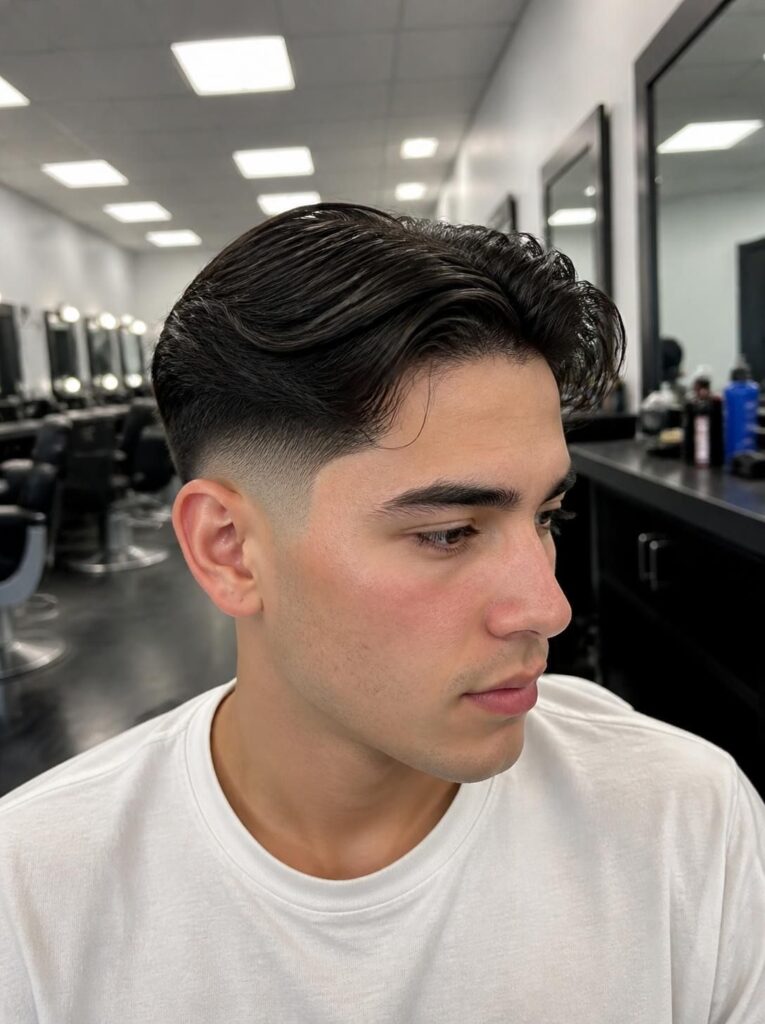
A low taper fade middle part is a two part haircut.
The sides and back get a low, gradual taper.
The top keeps enough length to split down the center.
Think of it as a neat frame with a relaxed center.
The sides stay tidy, and the top does the talking.
The low taper fade, explained

A taper shortens your hair slowly as it moves down toward the neckline.
In a low taper, that change starts low.
It begins around the ear and runs to the nape.
Most of your side hair stays in place.
Only the edges get cleaned up.
That’s why it looks soft and easy to wear.
A taper isn’t the same as a skin fade.
A taper leaves some short hair at the bottom.
A skin fade goes all the way down to bare skin.
Why the middle part works with it
A centered part splits the top into two even halves.
The hair falls to each side of your face.
It gives you a balanced, symmetrical look.
The low taper keeps the sides clean while the top moves freely.
That contrast is the whole point.
Soft on top, sharp around the edges.
Why the low taper fade middle part is so popular
This cut took off because it’s easy to like.
It looks modern, but it doesn’t feel extreme.
You can wear it in an office or at a party.
Here’s why people keep asking for it:
- It suits many hair types and ages.
- It looks neat even on a bad hair day.
- It grows out more gently than a high fade.
- It works with the 90s style comeback.
- It’s easy to show your barber with a photo.
The low taper is also a safe pick for people who want a fresh look without a big change.
You still get a clean outline.
You just keep more hair on the sides.
Who does it suit best?
Most people can wear this cut with a few small tweaks.
Your face shape and hair texture decide how it should look.
Your barber can adjust the details to fit you.
By face shape
Face shape changes how the part and the taper sit.
Use this as a quick guide:
- Oval: Almost anything works. A standard low taper and a classic part look great.
- Round: Keep some height on top and a tight taper. This adds length to the face.
- Square: A softer, slightly longer top calms strong angles.
- Heart: Keep the top fuller around the sides. This balances a narrow chin.
- Long or narrow: Keep the taper low and tight, and don’t go too tall on top. Extra height can stretch the face further.
A centered part tends to draw the eye to your cheekbones and eyes.
If that’s not the look you want, ask for a slightly off center part instead.
By hair texture
Texture affects how the top falls.
Here’s what to expect:
- Straight hair: It splits cleanly and hangs flat. Thin straight hair may need a little volume product.
- Wavy hair: This is the easiest match. The natural bend gives you flow with little effort.
- Curly hair: The curls create a full, rounded top. Keep the part loose and let the curls fall.
- Coily hair: You can define the part with a comb or a razor line. Keep the top moisturized.
- Thick hair: Ask your barber to thin the top so it doesn’t puff out.
- Thin hair: Keep the length medium and use a light product. Heavy gels flatten fine hair.
If you have a strong cowlick near the front, tell your barber early.
A cowlick can fight the part and push hair the wrong way.
Your barber can cut around it or move the part slightly.
Types of low taper fade middle part styles

There’s more than one way to wear this cut.
Pick the version that matches your hair and your daily routine.
- Classic curtain part: Medium length hair falls evenly on each side. It’s the most popular version.
- Textured middle part: The top is cut with shears for a messy, lived in feel.
- Slicked middle part: The hair is combed back and smooth. It’s a neat option for formal settings.
- Wavy flow: Longer hair rests behind the ears with a natural wave.
- Curly middle part: Loose curls fall naturally with a clean taper below.
- Low taper with a beard: The taper blends into the beard line for a tidy look.
- Burst taper variation: The fade curves around the ear for a bolder shape.
Each version uses the same base.
The change comes from top length, texture, and how you style it.
How it compares to other fades
Many people mix up fades.
Here’s a simple comparison.
- Low taper vs low skin fade: The taper keeps short hair at the bottom. The skin fade goes down to bare skin and looks sharper.
- Low taper vs mid taper: The mid taper starts higher, around the middle of the ear. It shows more contrast.
- Low taper vs high taper: The high taper starts near the temple. It looks bolder and needs more trips to the barber.
- Low taper vs burst fade: The burst fade curves around the ear instead of running straight to the nape.
The low taper is the softest option of the group.
That’s why it pairs so well with a relaxed middle part.
If you want more edge, go one step higher.
How to ask your barber for it
Clear words save you from a surprise.
Bring a photo, and say the cut in plain terms.
Here’s a simple script you can use:
“I’d like a low taper fade on the sides and back. Keep it low around the ear and the nape. Leave about three to four inches on top so I can wear a middle part. Please blend it smoothly and clean up the neckline.”
Mention a few extra points too:
- Whether you want a taper or a skin fade.
- How you usually style your hair.
- If you have a cowlick or a thin spot.
- How often you plan to come back.
Guard sizes help with clear talk.
Each number up adds about one eighth of an inch.
If you’re unsure, ask your barber to start longer and cut shorter.
How much length you need on top
Length decides whether the part works.
If the top is too short, the part looks like spikes.
If it’s too long, it can feel heavy.
Use these rough ranges:
- Minimum: About 2.5 to 3 inches. The part shows, but it sits close to the head.
- Best range: About 3 to 5 inches. This gives a soft, natural curtain.
- Longer flow: 5 inches or more. This works best for wavy and curly hair.
Curly hair looks shorter than it is, so you may need more length.
Straight hair shows its true length, so it can look good a bit shorter.
How to style it at home
Styling takes about five minutes.
The trick is to start with damp hair.
That makes the part easier to set.
Follow these steps:
- Rinse or lightly mist your hair so it’s damp.
- Use the tail of a comb to draw a straight line from the center of your forehead back.
- Blow dry the hair away from the part, left side to the left and right side to the right.
- Add a pea sized amount of product and work it through with your fingers.
- Shape the hair with a comb or your hands until it falls evenly.
- Finish with a light spray if you need extra hold.
Choose your product by texture:
- Straight or thin hair: Sea salt spray or a light texture powder for lift.
- Wavy hair: A light cream or matte paste for soft hold.
- Curly or coily hair: A curl cream or leave in conditioner for definition.
- Slick look: A light pomade, used sparingly.
Avoid heavy, shiny gels.
They can make the top look wet and stiff.
A natural, matte finish suits this cut better.
Maintaining the cut
The low taper is forgiving.
It grows out more gracefully than a high fade.
Still, the neckline and the area around the ears lose their shape first.
A good routine looks like this:
- Book a trim every 2 to 4 weeks if you want a crisp fade.
- Stretch it to 4 to 6 weeks if you like a softer grown in look.
- Wash your hair two to three times a week, based on how oily it gets.
- Use a light conditioner to keep the top smooth.
- Keep the neckline tidy between visits with a careful trim.
Your hair grows about half an inch each month.
That means the taper blurs after a few weeks.
The top will need a trim sooner or later as well.
Habits that trip people up
Small mistakes can change the whole look.
Watch out for these:
- Using too much product, which makes the top greasy.
- Forcing the part the wrong way against a cowlick.
- Waiting too long between cuts, so the taper disappears.
- Combing the part on dry hair, which makes it uneven.
- Cutting the top too short and losing the part altogether.
- Skipping a conversation about face shape.
Fix these and your cut will look better every day.
Picking the version that fits you
Start with your hair texture, then think about your face shape.
Then match the style to your lifestyle.
A simple rule helps.
If you want low effort, go with a textured or wavy middle part.
If you work in a formal setting, choose the slicked or classic curtain version.
If you have curls, keep the top loose and let the shape do the work.
Not sure?
Ask your barber to show you options on your own hair type.
A good barber will give honest advice about what works for you.
Frequently asked questions
What is a low taper fade middle part?
It’s a haircut with a gradual low taper on the sides and a centered part on top.
The fade starts near the ears and nape.
Is a low taper fade middle part good for thin hair?
Yes, if you keep the top at a medium length and use light products.
Heavy gels can flatten thin hair.
How long should my hair be on top?
Aim for about 3 to 5 inches for a natural curtain look.
Around 2.5 inches is the minimum for the part to show.
How often should I get a trim?
Every 2 to 4 weeks keeps the fade sharp.
You can stretch to 4 to 6 weeks for a softer look.
Does a middle part work with curly hair?
Yes, it works well with curls and waves.
Keep the hair moisturized and let it fall naturally.
What’s the difference between a low taper and a low fade?
A low taper leaves short hair at the bottom for a softer finish.
A low skin fade goes down to bare skin for more contrast.
Is this cut suitable for the office?
Yes, the low taper is a conservative fade that looks neat in most workplaces.
Is it right for you?
If you want a clean cut that still feels relaxed, this one is a strong choice.
It works with many face shapes and hair types.
It’s also easy to change as your hair grows.
Think about how much time you want to spend on styling.
Consider how often you can visit your barber.
If both fit your routine, you’ll likely enjoy it.
Want more taper fade guides?
If you like this cut, there’s more to explore.
Look into mid taper, high taper, and burst fade guides.
Each one has its own look and upkeep needs.
Comparing a few styles helps you pick with confidence.
It also gives you better words to use at the barber shop.

Cameron Wells is a fashion writer and style enthusiast covering fashion shows, emerging trends, designer collections, and modern style. With a strong interest in the fashion industry, Cameron creates clear, practical, and engaging content that helps readers understand seasonal trends, runway highlights, and evolving fashion movements with confidence.